Sunday, August 24, 2014

Video Cheese: The Video Edition

Note: These reviews were written for Video Cheese, a feature of www.jabootu.net. They have been published here by the kind permission of Mr. Ken Begg. God bless him.


VIDEO CHEESE: THE VIDEO EDITION
Today, we'll be examining some materials packaged exclusively for home video...


MULTIPLICATION ROCK (1987 - color)
" Cloris Leachman acts as host for a series of videos from Schoolhouse Rock!"

   And really, it's not any more complicated than that.

   This video is a themed collection of segments from the popular Schoolhouse Rock! series, played with the addition of newly-shot wrap-around footage depicting famous actress Cloris Leachman dancing and singing with some very peppy kids.


   Okay, Schoolhouse Rock! was an infamous collection of cartoon shorts aired on kiddie block television beginning in 1973. Although the animation and design were very crude, the show used music to help kids remember basic principals like history, grammar, civics, and, in the case of this collection, math. With an aggressively modern and largely urban aesthetic, the shows used catchy pop-like tunes to help kids grasp what they were learning in school. And it seems to've been very effective. Not only does the program remain a broadcasting staple to this day, but it's memorable tunes and distinctive style have kept it in the hearts and minds of many adults who count it among their top ten on the nostalgic hit parade.

   The show was an ABC staple until 1986. A year later, this video was created (presumably as part of a series) to bring the classic show into your own home (I understand a definitive collection has just been released by Disney, which gobbled up ABC some years back. I wonder if they thought about including the wrap-around footage from these videos as an extra feature). 

   For whatever reason, they don't just compile the cartoons and let them speak for themselves, feeling the need for this new footage to write a jazzy new theme song. This does make sense, as it was common practice to fill kids' programming at the time with energetic kids who would sing hopefully-catchy songs (likely due to the example set by The Mickey Mouse Club decades earlier). That's provided you feel new footage was needed in the first place, which even as a child, I wouldn't have.

   (Kiddie show hosts become stars to most children, but I always thought they were eating up time in which they could be showing cartoons, which I thought was the main draw of such shows. I was a bit of a jerk at times, yes.)

  When the actual snippets from the original show begin, we're taken through a series of mathematical songs devoted to the numbers 2 through 9, and then a special tribute to Zero. We're obviously looking at a different time, here. Not only are kids shown running around outside, but the '2' song even uses Noah's ark as the means to demonstrate the power of 2. 

   I notice '1' isn't included in the parade. I guess it really is the loneliest number...

   The box makes sure to promote the involvement of Cloris Leachman, who I'm sure the kids were all crazy about in 1987.......

   I assume the actress was involved behind the scenes in some capacity. Maybe the videos were her idea to begin with, and one of the other producers suggested she appear in new footage to give the videos some extra juice? Whatever the reason, she's there in all her glory twisting around with a bunch of kids, towering over them like King Kong in a native village. 


   They've done what they can to make her look glamorous, but it's still Cloris Leachman, in 1987 yet, so she's still going to look like Cloris Leachman. I don't wish to sound rude or unchivalrous, I've just never found her to be all that attractive. Seeing her early work, in fact, is like watching a completely different actress.


   Born in 1926, Leachman was Miss Chicago of 1946, and competed in the Miss America contest! She later found decades of employment as a television actress, doing just about every major show you could think of. This includes parts on Ironside, Adam-12, Dr. Kildare, Perry Mason, Gunsmoke, Hawaiian Eye, The Big Valley, and many, many more! Her first major part was as the Mom on Lassie back in the 50's (the version of the show, I believe, which was alternately titled Jeff's Collie), and of course she would later become a part of Mel Brooks' stock company. She may be best remembered in the long run for playing Frau Blucher in YOUNG FRANKENSTEIN.

   For genre fans, she had a small part in KISS ME DEADLY before doing a One Step Beyond ("The Dark Room") and a Twilight Zone ("It's a Good Life"), as well as three Alfred Hitchcock Presents episodes! In the 70's, she did two Night Gallery shows and played Hippolyta in the Wonder Woman pilot movie for the Lynda Carter series which followed (where she was replaced by former Morticia Addams, Carolyn Jones). She did a Muppet movie, a Herbie movie, and provided narration for the 1991 Richard Keil-scripted and starring THE GIANT OF THUNDER MOUNTAIN, but that's among countless other things. She even won an Oscar for THE LAST PICTURE SHOW

   She really doesn't do anything of note, here, though. No more than we see, her scenes could have been given to any actress, or removed altogether! Adding to the pointlessness of the new footage, a lot of it just has one of the kids shouting the title of the next song at the camera before it starts in earnest. They even flash the name of the song we're about to hear.

   Although MULTIPLICATION ROCK isn't without it's charms, it seems an odd format for a learning tool. The skits should have been placed on the tape by themselves, although I have my doubts that I, as a grade-schooler, would have retained all this. I think the songs might be stronger if seen one at a time, allowing for reflection on the principals of one number before launching directly into another piece. And if one of these songs could be screened right before a test focused on that particular number, even better!

In the end, I don't think it'll replace DONALD DUCK IN MATHMAGICLAND.....


Thursday, August 21, 2014

Naked To Hell

   NAKED TO HELL was a short story meant to evoke early 60's exploitation films. This is the properly lettered version, one I hope to find a home for one of these days. Enjoy. (Note: I in no way endorse nudism, I'm just trying to tell a good story.)


Saturday, August 2, 2014

Oddball Film Report: LITTLE RED RIDING HOOD

NOTE: This piece was originally written for use by Ken Begg's www.jabootu.net. It has been published here with his kind permission.


LITTLE RED RIDING HOOD (1959-color)
   "The Mexicans extend their own brand of magic to the tale of Little Red Riding Hood, and the little lady will never be the same!"

   If you haven't seen a Mexican-made children's flick, you may have a better handle on your sanity than those of us who have. If you have seen one of these films and survived, you know first hand that special (if oft-nightmarish)  brand of magic they possess.
   Americans often observe the media consumed by Japanese children and we sort of shrug. There's something going on there we can't fully understand. This condition is somewhat magnified when we're exposed to the sort of fare made for children south of the border.  This stuff is SO wacky, its hard to imagine that any Mexican children ever grow up to be well-adjusted adults! Americans who hobby in oddball movies may expect to see three or four of these films over a lifetime. It sends chills up the spine to think that generations of impressionable young minds were steadily exposed to fare like this!

    Jabootu readers will recall Ken's examination of SANTA CLAUS, in which the Right Jolly Old Elf lived in a castle in outer space with hundreds of children and Merlin the magician, and travelled to earth one night a year where he delivered toys and fought the demon Pitch for the souls of all the children on earth (or at least a handful of tykes in Mexico). 
   I've previously reflected on PUSS N BOOTS, in which a midget in a stuffed cat suit sword-fights a magic ogre and his army, with the aid of a three-foot, talking chicken. And yet, these films may pale in the face of the screaming weirdness that is LITTLE RED RIDING HOOD!

   Where to begin? The opening credits are scored with music more fitting a horror film (how honest!) despite the storybook illustrations moving across the background. A couple of times we dissolve into actual footage from the movie, including a good shot of The Big Bad Wolf. 


   Right there is most of the problem, as the Wolf has to be one of the most nightmarish things I've seen in my adult life (I can't imagine how it must have come across to children seeing this on a 60 foot screen). Basically, it's a guy in a baggy wolf suit, which would be okay were it not for the actor's exposed eyes and forehead. Seeing part of a human face surrounded by a costume that's just realistic enough to have worked on its own (the mouth occasionally looks remarkably life-like), is the kind of thing that messes with your senses. It looks less like a man in a parade costume than it does something Dr. Frankenstein threw together one night after a bender.

   That's only the start of what's wrong with the character, however. Normally, I don't imprint unintended sexuality upon a film* (that swimming scene in CREATURE FROM THE BLACK LAGOON, for example, despite much hoopla from critics in recent years, has nothing to do with sex). Here, though, is a really uncomfortable situation as the Wolf salivates upon seeing little Red. He jabbers on about how pretty the young girl is and how tasty she must be before giving in and howling uncontrollably. His sneaking peeks of the girl and going through this routine has a VERY creepy vibe to it. One I'm sure the film makers never intended, let me be clear. The way the wolf pants upon seeing Red, though, would be a lot less disturbing were she not a child. It's like someone accidentally hired the Tex Avery Wolf to do a Disney cartoon. 


[* I note a similar uncomfortable reflection arose in my review of SANTA AND THE ICE CREAM BUNNY, or more specifically the THUMBELLINA  featurette within it, in which every animal in the forest seemed determined to force Thumb into marrying them. That was uncomfortable enough, but this film is downright disturbing at times....]
 

   As if that weren't bad enough, the Wolf has a sidekick: Stinky the Skunk. Stinky is slightly less terrifying because this actor's face is more or less completely covered by the skunk mask, and the exposed flesh around his eyes are painted to match the colors of the costume. 

   Stinky is a short fella, roughly as tall as our Shirley Temple-ish heroine, and I'm pretty sure is played by the same guy who played Puss N Boots (some of his movements indicate this, and I'll admit the guy is very talented, and limber). Stinky should be a cute counterpoint to the Wolf (who is the only creature who will -barely- tolerate Stinky's odor, thus their partnership), but any chance of that is lost when he speaks. He has a stuttering high-pitched voice like Chip and Dale (actually, he sounds exactly like some cartoon character that I can't recall -I'm thinking a bug or something from an old Disney one-reeler that's no longer allowed on television). That isn't so bad, but he keeps breaking into fits of laughter that quickly become more creepy and unsettling than charming or funny.

   He also falls in love with a parrot owned by Little Red Riding Hood and will serenade the bird (something slightly less freaky than seeing Puss N Boots stroke a tabby and proclaim his undying love).

   Red herself, meanwhile, isn't immune from the freaky-factor. While the little girl playing the part is cute and aggressively cheerful, she occasionally breaks into song and her singing voice is that of an adult woman! This too, can actually throw the viewer off balance. 


   Another mystery is where this film is taking place. The town is celebrating Mardi Gras and the local preacher wears the uniform of a Mexican priest from about 100 years earlier, yet everybody else wears costumes that more suggest Germany of the same era! And like in SANTA CLAUS, there are weird, out-of-left-field references to God that seem to run counter to the stuff we're seeing on screen.

   As we open, Red is having an argument with local trouble-maker Freckles (a poor little boy who probably HAD to become the town bully lest he get beat up for his name alone) as to if a local legendary fairy is real or not. 


   There's this rock on a hill that vaguely -very vaguely- looks like an angel when the sun back-lights it. Red insists the fairy is real, but this won't play much of a part in the following story. 

   Red makes for home, and runs across the singing band of woodsmen who live in the village. As the men drop the little girl off outside her home, they all gush over how pretty the girl is. I guess she's going to grow up to be the town's most beauteous babe, because these guys keep going on about how she's the prettiest gal in the world and I'm guessing they're setting the grounds for courtship when she finally blossoms into womanhood. Or else everybody thinks there aren't enough tots in the town with a swelled head.

   Inside, Mother has just finished making the titular cape and hood. Upon being seen in these garments for the first time, everyone proclaims her new official name to be Little Red Riding Hood. This is practically made a public policy as the town Mayor (whose long white beard doesn't match his curly blond hair!) and every other adult in town continues to gush about how pretty the child is during the Mardi Gras celebration. 


   (The film introduces a young couple "Peter and his Girlfriend" who don't really do anything once they're established. Peter's Girlfriend is a hot babe who's the daughter of the local Priest, and that's about all we ever bother to learn about them. Oh, we also learn they're good dancers because they win the dance contest, but then we're done with them!)

   The Wolf and Stinky sneak around the Mardi Gras and spy out Little Red, but get distracted by the wrestling exhibition. The Wolf, you see, fancies himself better at everything than anyone else is. Upon creeping close enough to see the dance contest, he is horrified to see the humans are doing the Polka! Rather than being aghast at this weird relocation of a European dance to turn-of-the-century Mexico, the Wolf insists he's the best Polka dancer in the world and demonstrates that he, in fact, is terrible. 


   Seeing the fights, Wolf grabs Stinky and demonstrates multiple holds on the hapless creature. Wolf is also a master of disguise (and everyone in town is either blind or stupid for this to work), trying to trick his way into Red's house by posing as a saleswoman selling fine fabric and thread. 

    Mother doesn't want any, but she never seems to be horrified of the monstrous creature she earlier warned Red to avoid. She doesn't let on, but I'd assume Mother was also a bit disturbed about this "woman" coming to her door and then drooling over her young daughter as the child lay in bed. "She looks good enough to eat" is said a couple of times.

   Stinky collects information on Red, giving him a chance to see the parrot and fall madly in love. (Actually, and I'll grant that I can't understand everything Stinky says, I think he mentions the parrot as being male! So, Stinky is a girl? Or is this even weirder than I gave it credit for? I think one of the things Stinky says is "I'll love him like a brother" but I can't be sure because of that voice! I am pretty sure Wolf refers to Stinky as being a male....) He'll come back later and serenade the bird with a mandolin! 


   (Actually, and as weird as these films are, it's hard to trust your own recall, I think in the sequel(!) film, Stinky spells out his attraction to the bird as being romantic as opposed to platonic. At no time is there any indication Stinky is a female, however! In fact, I'm certain Stinky is called "he" in the films....)

   At any rate, Freckles runs into the woods and runs afoul of the Wolf. An intense search reveals no sign of the child. 


   The Wolf tries to break into Red's house while Mother is out, but the hunters get back to town in time to see the Wolf at the door and promptly shoot him in his hairy duff. They track the Wolf over the next few days and eventually near his domain. There, they find some bones and assume the Wolf has been finished off by the buzzards. Wolf watches from his lair.*

   (*Here is another element that doesn't seem remotely familiar to my American memories of the tale. Wolf and Stinky live in the trunk of a sinister-looking tree that vaguely resembles a howling wolf. This is right next to a cave known to the townsfolk as "The Devil's Abode" which comes complete with a prophecy stating the evil of the place will only be expelled when confronted by a person who has been cleansed of all evil! I don't recall a curse in the version I heard, do you?)


   (This cave, by the way, seems to be Mexico's Bronson Canyon, as it turns up in any Mexican movie that needs a cave. I'm pretty sure this is the same cave where Puss fought the Ogre, and I know for sure it was the landing site for two space women looking for male specimens in SHIP OF MONSTERS, a film which sadly never saw US release. I also think Santo fought Dracula around this same spot!)

   The last quarter of the film concerns the familiar story of Red taking a visit to Granny's house, with the Wolf plotting to eat Red by posing as the old lady. Before we can get that far, though, Red gets sidetracked and looks for Freckles in the Devil's Abode....


   Said cave is suitably nightmarish with dark walls, but even here they don't leave well enough alone. Red comes across a giant spider (!) and starts to interview it! Looking the eight-foot arachnid in the face, Red promptly asks "You're a spider, aren't you?" Red then acts confused when the monster refuses to speak (I'll allow this, given that she'd earlier talked to Stinky, and she had noted how friendly all the other animals of the woods are.) Rounding a corner, Red continues this routine with a crocodile!

   Finally, Red wanders into a large cavern where she spots a huge black rock. Seeing something I don't, Red starts screaming at Satan, telling him he'll have to answer to God. The Evil One gets the hint and scrams in a puff of smoke. Outside, the tree explodes (!) and no longer resembles a monster wolf! 


   The spell over the place lifted, Red finds Freckles and sends him home. Also in evidence are several lambs earlier abducted by the Wolf. Maybe the Wolf wouldn't be complaining about his hunger as much if he had actually bothered to eat some of his catches!!!! 

   Meanwhile, I can't help but note that Red was not a person cleansed of all evil. As a child, she would still possess innocence, and thus not need cleansing as I understand things. Either way, we never see any form of cleansing to nominate Red as the one to fulfil this prophecy. It's just another example of weirdness on display.

   From here, we get the traditional story, with the Wolf about to eat Red at Granny's house when the woodsmen arrive and string up the Wolf in the town square. Preparing to burn him with green wood the townsfolk refuse to hear the Wolf's cries of repentance. Stinky even runs in, ready to throw the first torch! 


   Red, however, forgives the Wolf, and the townsfolk follow her lead. In fact, they appoint the Wolf sentry to keep other animals out of the town limits!! Red makes a gift of her parrot to Stinky before its over!

   As if all this weren't enough, the film sired TWO sequels! LITTLE RED RIDING HOOD AND HER PALS, and LITTLE RED RIDING HOOD AND TOM THUMB VS THE MONSTERS were pushed out in short order! (For what it's worth, those two entries are a bit better. Maybe it's being settled into the insanity, but I found the sequels much more enjoyable upon their first viewings.)  


   In LITTLE RED RIDING HOOD AND HER PALS, Wolf and Stinky find themselves victims of a plot to discredit them with the villagers (with whom they have largely forged a good relationship). Tossed out of town and out of uniform, the pair have a huge fight and go their separate ways. Meanwhile, a band of gypsy wagons has pitched camp outside Red's house. When the vagabonds abduct Red before leaving town, it's up to Wolf and Stinky to rescue her.

   Finally, LITTLE RED RIDING HOOD AND TOM THUMB VS THE MONSTERS finds the reformed Wolf and Stinky tossed out of the league of monsters. Wolf and the Ogre, tamed by Tom Thumb in his own movie, are sentenced to die for their lack of crimes! As Wolf and Ogre work to escape, Stinky heads off on his own and finds Red and Tom, rushing them along to find help. During all this, the wicked Queen of the monsters (an exact, if three dimensional, recreation of the Wicked Queen in Disney's SNOW WHITE AND THE SEVEN DWARFS) tries to stop the forces of good by turning everyone in Red's village into animals! Our heroes must fight their way into the Queen's castle, which is brimming with monsters, many seen in other Mexican movies. Fortunately, goodness prevails in the end.  

   Nor was that the end of it. The films were very successful, and Wolf and Stinky became headline characters for distributor K. Gordon Murray. They, and other popular characters from Murray's Mexican stable, were reunited for a series of featurettes shot in kiddie play parks which catered to a Christmas theme. This new footage was mixed with some stock shots from SANTA CLAUS, to detail the events at one of Santa's toy factories. Santa and Merlin the magician (from SANTA CLAUS) would hang around while an assortment of kids were busy making toys (the main assembly line workers were a line of pretty teenage girls dressed as Peter Pan, for some reason). Puss N' Boots served as head of security, while the Wolf acted as foreman of Santa's toy factory. Stinky was among the gaggle of toy builders!

   Considerably smaller scale than the Mexican productions, Wolf and Stinky were brought to life with some threadbare suits of the parade costume variety. Stinky was given a wider jaw which almost suggested his mask had been reshaped from a Donald Duck mask. Wolf looked particularly ratty, seen as a baggy, threadbare body suit sewn together from two different colors of fabric (his tail, similarly colored, looked in constant danger of falling off). His over-the-head mask drooped down in front and his lower jaw flopped about off center from the top jaw. His completely expressionless mask looked like a plush toy (while Stinky's mask had considerably more animal-like features than did the original costume). Despite how poorly executed the costumes were, however, they did away with the visible human eyes of the Mexican versions, and thus were much less frightening!

   Again, I find it hard to imagine a childhood filled with such fare. Political corruption and economic decay can't be all that makes people become desperate enough to flee into another country, the laws of said country be hanged. I think they're trying to find less scarring entertainment for their children. Just goes to show, there's a lot more that separates countries than just border and language! 

Tuesday, July 29, 2014

Video Cheese: BLACK ANGELS (1970)

Note: Here's another mini-review prepared for www.jabootu.net's Video Cheese feature. It has been published here with the kind permission of Mr. Ken Begg.


BLACK ANGLES (1970 - color)
    "A race war on wheels!"


   First, let me note how impressed I was with this video tape. The transfer was simply gorgeous and the print was in fantastic shape for such an obscure title as this. 

   That's one thing I really like about 80s video cassettes, the source prints for movies like this tend to look much better because the prints were much younger than they are now (and age has had time to rough up these things in the meanwhile). At the time, you could still dig up some really nice prints of some really obscure junk. Upon seeing how sharp this print was, I automatically granted the film some points of favor. It would have to be pretty bad for me not to have a little affection for it after seeing such a nice picture. I would like to acquire more tapes from Trend Video and see how they stack up.


   This makes the fifth biker flick I'd seen at the time of writing this review. I really enjoyed two of them (The Hellcats, The Born Losers), and felt really let down by two others (Cycle Savages, The Wild Angels)*. Where does that leave Black Angels? Smack in the middle, really. It had some good elements and some bad elements. 

[* I've since seen a few other films in the genre. Most have been pretty bland, but the occasional gem like THE WILD REBELS has also come my way.]

   Like the worst of biker flicks, there was much meandering and seemingly endless filler material. Like the best of biker flicks, this one had a plot. Sort of. It doesn't demand a lot of space to review for that very reason.


   The title refers not to a gang of black bikers, the Choppers, nor their white counterparts, Satan's Serpents. The Black Angels are actually the highway patrolmen who observe the doings of the gangs from a distance. One cop in particular has a plan to end the reign of lawless terror these gangs engage in, and he's planting the notion that the two gangs are headed for a race war. The bait set, he sits back and waits for both gangs to destroy one another.  That's actually a pretty neat plot for one of these pictures.

   Don't get the wrong impression, though, the main action all takes place within the last five minutes or so, it still takes 80 largely non-eventful minutes to reach the climax.


   Mostly, we watch the misadventures of Chainer, leader of the Satan's Serpents. Playing Chainer, our star Des Roberts never really did anything else a lot of people have seen. He acted in something called The Demons, a witchcraft movie so obscure the IMDB doesn't have a year for it (though it seems to be on DVD...somewhere), then a homosexual hardcore flick called Dracula and the Boys! Then our current subject, and finally another Dracula movie. He plays the king of the undead himself in Guess What Happened to Count Dracula, and even worked on that film's soundtrack. I've not seen Guess What Happened to Count Dracula, but I do know Something Weird Video sells one their impressive double feature DVDs featuring the film. Other cast members here also turn up in the Dracula movie.


   Roberts has that whole Peter Fonda thing down here, so that would seem to be why they cast him. He commands unquestioning respect and loyalty from his men, and his women. He's a jerk, but as the Leader you're forced to give him a little credit and respect, like some kind of (survival?) instinct.

   Chainer's gang hangs out in a ghost town, and have a chained mountain lion in a barn! Why? We never really know why they have it. Maybe it wandered in by accident one day and they trapped it, thinking it a fun conversation piece?


   Our actual plot revolves around Johnny Reb, a southern biker who wanders into town and hides from the fuzz in Chainer's ghost town. He's played by another unknown who also appeared in Guess What Happened to Count Dracula. Reb joins the Serpents, then starts spouting racist slurs when the gang stops off at a beer bar and are served by a black waitress. (He's from the south, you know, so obviously he's a racist. Such was the mandate of 70's exploitation movies.) 

   Chainer sets him straight, their beef with the Choppers is over turf, not color. "This country," Chainer sighs the film's best line, "its getting so you can't have a decent fight with a black man without somebody making it out to be about race."


   Reb later picks up some "uppers" from a car in a dark parking lot, despite his claiming to be new in town he has not only found a supplier, but one who doesn't take money! Unfortunately, by the time Chainer figures this out, he and his gang have already taken Reb's little gift. They're downers, and everyone is now vulnerable. 

   Reb goes outside and rips off his confederate cap before signalling to the Choppers who are waiting on the hillside. He slips into a Choppers jacket. Questioned, Reb laughs "I'm black!" There's a line after this that may clear things up a bit, but I couldn't catch it due to the roaring motorcycles. (Is he supposed to be a light-skinned black man? An honorary Chopper, allowed to hang out with the cool kids after helping them destroy their enemies? Has he been dyed white?)


    Although doped, Chainer and his men put up enough of a fight to kill everyone in both gangs. Then there's the now escaped mountain lion, who rushes out to chew one guy to death before moving on to another victim! Chainer and his opponent end up falling into a snake-pit! 

   The Black Angels pull up to observe their handiwork, then drive off knowing a threat to the community has been neutralized. Over the images of various white and black guys dead at each other's hands, we get a song about peace. How ironic, or tragic, or arty, or something. I don't know about you, but it makes me want to hug somebody.


   Again, not gang-buster stuff, but mildly better than one usually expects from a biker flick. Although cheap, the film is technically well mounted. There are some familiar backdrops here, as one might expect from any California-filmed cheapie of the period. Amazingly, they avoid using Bronson Canyon entirely!  

   All this was directed by Laurence Merrick, who also helmed the aforementioned Des Roberts movies. The obscure beyond obscure The Demon, the hopefully lost Dracula and the Boys, this, and Guess What Happened to Count Dracula. His only other work is a 1973 documentary Manson, about the infamous cult-leader/killer. The Database notes that he was shot and killed in 1977, by a deranged stalker, lending a darkly ironic touch to his body of film-work involving killers, psychos, and vampires.

Monday, July 21, 2014

Reflecting on Gammera/Gamera

Gammera, he's invincible!

   Japanese monster movies really took off in the mid 60's. In particular, the years of 1966 and 1967 saw just about every Japanese movie studio (with the size to attempt it) release at least one giant monster movie following the success Toho studios was having with the Godzilla movies. The only studio to really make a go at a continuing series was Daiei, who in 1965 kicked off a series of films built around a monstrous prehistoric turtle. The first film, shot in spooky black and white, was imported a year later and released in the States as GAMMERA THE INVINCIBLE.

   The film detailed the efforts of mankind to destroy a prehistoric monster unleashed by an un-planned atomic blast at the North Pole. Gammera wasn't just any ordinary giant prehistoric reptile that could spit fire, however! Gammera actually thrived on flames and heat, and grew stronger as the military attempted to kill him! Moreover, through a means I've never been able to figure out, he could also fly! By pulling in his limbs and spinning, Gammera was somehow able to take flight! What's more, he was so massive and powerful that he caused disruptions in the weather and tides!


   GAMMERA THE INVINCIBLE was a box office success on both sides of the Pacific. The American cut was actually superior, given a nice political flavor in the addition of new footage featuring American stars like Brian Donlevy and Albert Dekker. Happily, the new footage also provided a rare meaty role for character actor Dick O'Neill fairly early in his career.

   Gammera was practically indestructible on Earth, so the only solution was to get him off the planet. Gammera was trapped inside the nose-cone of a massive rocket and shot into outer space! Oddly, he wasn't the only monster to be ejected rather than outright killed, as 1967's THE X FROM OUTER SPACE ends much the same way (however, that film didn't require construction of an outlandishly huge missile to accomplish this task).

   In Japan, Gammera was pressed into service for a second film. State-side, American International Pictures began scooping up Japanese monster movies for it's television division, knowing any color giant rubber monster epic was a guaranteed ratings-grabber. beginning in 1968, this included the Gammera movies, and the American studio even helped finance the pictures and suggested ways to keep the films profitable in the all-important American market.

   AIP's dubbing changed Gammera's name to Gamera (the pronunciation changing from Gam-rah to Ga-meer-ah), and began their slate of films with 1966's WAR OF THE MONSTERS. In this entry, which remains the most adult and moody of the lot, explorers go searching for a rare jewel which turns out to be the egg of a monster that is quickly running around loose in Japan. Meanwhile, Gamera has been freed from his rocket prison when a meteor collides with it. Gamera heads right back to Japan to bust up a dam before flying off to find ever greater sources of heat.

   While Gamera no longer causes environmental devastation by his very presence on Earth, he's still a monster here. With the newly hatched Barugon on the loose, however, Gamera is the lesser evil. Fortunately, he also proves the stronger, and after a couple of rounds, ends Barugon's terror and sets off to find another active volcano somewhere.


   WAR OF THE MONSTERS was a high mark for the series, but it was noticed the mostly-child audience wasn't being entertained by all the adult-oriented drama. The series pressed into a third chapter, and the focus was on action and adventure rather than human drama. To this day, THE RETURN OF THE GIANT MONSTERS remains heralded as the finest entry in the saga, and one of the best of all Japanese monster movies.

   This time around, an active volcano attracts Gamera back to Japan while also unleashing the literally blood-thirsty monster Gaos from a subterranean lair. Gamera fights off Gaos, and firmly establishes himself to be a hero. 

   The development here is interesting, as the course of the three films shows Gamera becoming more and more attuned to humanity (in the AIP dub, he even understands English!). While this is never actually stated, it seems Gamera is highly empathic to human thought waves, and becomes less and less alienated from the human race (in particular, he gets along with children extremely well). This tendency would grow stronger and stronger as the series progressed.

   Of note, with this entry Gamera gets a peppy theme song.


   Up till now, the Gamera movies were pretty sedate, comparing favorably to the Toho adventures being made at the same time. As kids were the main audience for such films, though, 1968 saw the series take a severe turn into the goofy. From here on out, kids would be the focus of the series, which became increasingly akin to Saturday morning programming. At AIP's suggestion, the next few films would also feature American kids in addition to Japanese ones.

   DESTROY ALL PLANETS saw Gamera at odds with would-be invaders who sought to conquer Earth. To facilitate this, the creatures of planet Viras take two boy scouts hostage and hold them ransom for the rest of the world. Since the UN is in charge of negotiations, Earth quickly surrenders. Fortunately, Gamera is on hand to actually fight back, although he briefly falls under alien mind-control. In the last act, the Virans combine into a giant squid-type critter which inflicts upon Gamera damage that would normally kill even a giant Japanese monster!


Behind the scenes


   Gamera next took flight in ATTACK OF THE MONSTERS. Without doubt, this was the wildest entry of the entire series, concerning as it does Gamera's flight to a planet on the other side of the sun to save two small boys from being eaten by space women! What's more, Gamera meets his most infamous enemy, fighting off a knife-faced monster called Guiron! Weirdly, this is the film that would probably see the most American airtime thanks to AIP-TV.


   With the dawning of the 70's, Gamera got a little of his dignity back, when GAMERA VS MONSTER X got a slightly larger budget and a plot that echoed his earlier adventures. This time around, scientists unwittingly release a prehistoric monster when they remove an ancient totem pole from a tropical island. Turns out the statue kept in check the hideous Jiger, and now the monster is loose and heading for Expo 70! 

   Although it has it's cartoonish moments, GAMERA VS MONSTER X is a step back up for our hero. Sadly, this situation would be rather quickly reversed....


   GAMERA VS MONSTER X would be the last Gamera movie AIP-TV would release. GAMERA VS ZIGRA was made while Daiei was going bankrupt, and the film being finished at all is a bit of an achievement. It's also really goofy.

   In an extremely convoluted plot, a lounge singer/actress/something visiting the moon is zapped aboard an invading spaceship and brainwashed into aiding the Zigrans in their plans to subjugate all land-dwelling life forms into becoming food for the aquatic aliens. When some scientists and their children are zapped aboard the same ship, the kids manage to escape. Zigra demands the children be tracked down and killed for fear they have overheard the plans of the aliens, right after broadcasting their plans to the world via television. Fortunately, Gamera shows up and destroys the alien ship. Unfortunately, it's alien pilot grows to the same size as Gamera and defeats our hero in battle.

   Not to blow the ending or anything, but Gamera eventually returns and takes care of business, saving Earth once again. He couldn't save his studio, however, so although plans were made for another episode, it all ended right here.


   Daiei eventually scraped together enough capital to re-open it's doors, and it was felt a way to raise some quick cash might be with another Gamera movie. How do you make a giant monster movie with no budget? You film some silly superhero movie and pepper it with stock footage from all the previous Gamera movies! 

   The result was SUPER MONSTER in 1980. Although mostly a collection of earlier battle scenes re-written to be Gamera struggling against an alien invader's army of mutations, a few new inserts of a flying Gamera model were employed. The bulk of the plot dealt with a small boy and his relationship to three women who turn out to be superheroes from a distant galaxy at war with an oppressive despot known as Zanon.

   The girls transform into their super-duds by doing an elaborate dance routine. Unfortunately, they can be tracked whenever in their super-forms, so a lot of time is wasted showing them go super, get shot at from space, and then go back to their civilian identities via another dance number. The film is repetitious in the extreme, and listless as well. Of particular detraction is Gamera's boring new theme music. SUPER MONSTER bombed. I believe the studio slid back into bankruptcy.


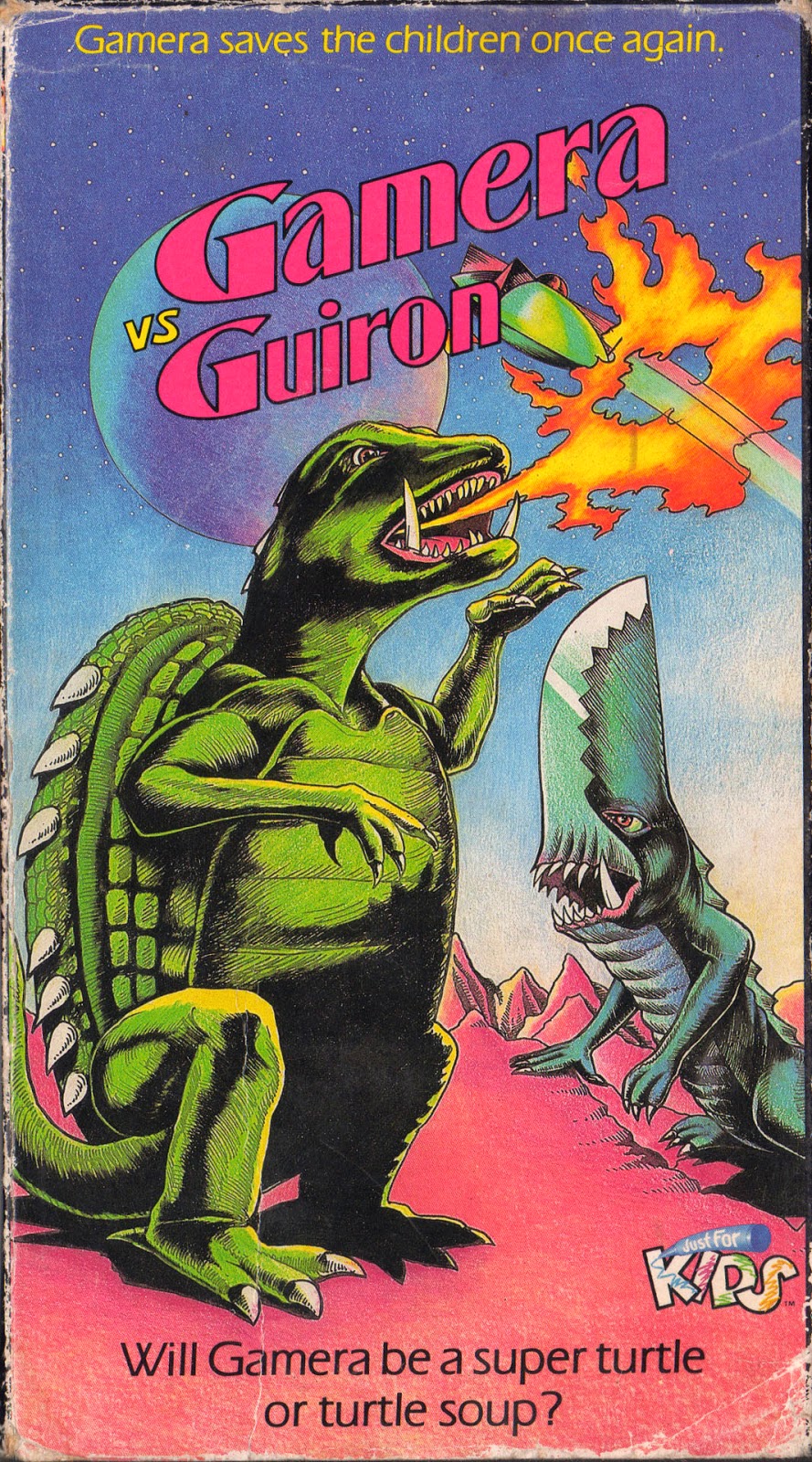
   While the AIP-TV prints of the Gamera movies were still turning up on UHF stations across the Americas, they would eventually fade from view by the end of the 80's. Along comes prolific producer Sandy Frank, who's looking to cash in on the video craze. As did K. Gordon Murray before him, Frank purchases a large number of foreign movies and TV shows and recuts them for consumption by American kids. Who among us, of a certain age, will ever forget the heyday of Celebrity Video's Just For Kids line, which included such fare as TIME OF THE APES, FUGITIVE ALIEN, and the anything but kid-friendly THE "LEGEND OF DINOSAURS" in all their VHS glory? The line also served as a re-introduction to Gamera the flying turtle to American audiences.

   Frank got a number, though not all, of the Gamera films and re-packaged them with new credit sequences. In most cases, he also found the original International dubs for the films he acquired (creating new dubs for the couple that didn't have such dubs available). Marketing Gamera as a hero for the video tots, the films entertained a new generation, and was again a popular electronic babysitter. (Also of note is that the pronunciation of Gamera's name returned to Gam-rah during this period.)

   Frank's line consisted of GAMERA (a straight dub of the film previously re-worked into GAMMERA THE INVINCIBLE), GAMERA VS BARUGON (the International dub of WAR OF THE MONSTERS), GAMERA VS GAOS (ditto for THE RETURN OF THE GIANT MONSTERS), GAMERA VS GUIRON (a new dub on ATTACK OF THE MONSTERS), and for the first time in the States, GAMERA VS ZIGRA.


   A few years later, a number of films in the Sandy Frank video library, including all of his Gamera releases, became the subjects of Mystery Science Theater 3000, where Gamera was introduced to a whole new new audience. It's well argued that Gamera's major fame in the new Century is the result of his adventures being watched and commented upon by Joel and the Bots. With this, Gamera went from Godzilla knock-off to pop culture icon in the United States. As well, the MST lyrics for the Gamera theme song have become just as popular.

ATTACK OF THE MONSTERS as GAMERA VS GUIRON on Mystery Science Theater 3000

   As Gamera was being re-invented by Mystery Science Theater 3000, he was also being re-invented by the Japanese. As Daiei managed to recover itself by the 1990's, plans began to surface of a revived Gamera series. Godzilla had been regularly brought back to screens in the same decade, and it seemed only natural other studios might try to cash-in.

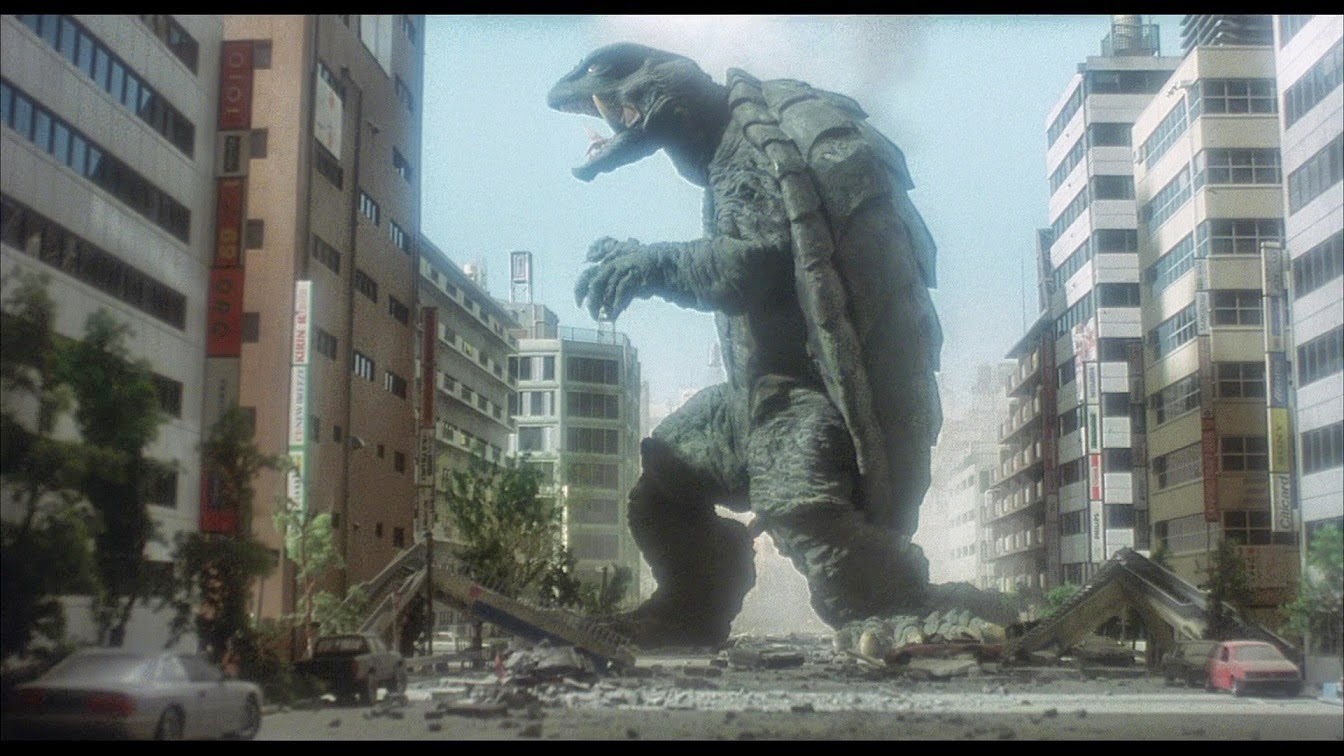
   At first, it was thought Daiei should make a cheap, kid-friendly little monster movie that could be released to matinee audiences. Then, something happened. It was decided any studio could be lazy (and indeed that word sums up the 90's Godzilla series perfectly), so the new Gamera film would try. It would try very hard. The result is one of the finest displays of special effects ever seen anywhere in the world. 1995 signalled a crowning achievement, the release of GAMERA, GUARDIAN OF THE UNIVERSE.

   This film re-cast Gamera as a man-made device. An ancient civilization had built Gamera to destroy ravenous flying creatures called Gyaos. When Gyaos suddenly reawaken in the 1990's, so does Gamera....


   GAMERA, GUARDIAN OF THE UNIVERSE was a smash hit. Daiei quickly re-trenched and put even more effort into 1996's GAMERA 2: THE ADVENT OF LEGION, which had some people proclaiming it to be the single finest Japanese monster movie ever made. Gamera had finally made it.

   In GAMERA 2, our hero is nearly defeated by a virus-like monster which feeds on silicon, and can break down into thousands of smaller creatures. The same year's Godzilla film had a much similar plot, but it was easily outclassed by the Gamera movie. 

   Although the film relies a bit too much on digital effects, the practical stuff is even more impressive than that seen in the previous film. The film was hailed as a landmark in the genre, and raised hopes for the genre's revival. Although the explosion of the 60's was never duplicated, it was around this period that Japanese and other Asian producers began to play around with the genre again. 

   For whatever reason, though, Gamera would sit out the next three years...


   It wasn't until 1999 that fans finally got the promised third entry, GAMERA 3, THE REVENGE OF IRIS. The resulting film was much darker than the previous films in the cycle, which has some fans split on it's merits.

   In the story, Gamera is losing his touch with humanity (which was much more straitly explained in this series) as environmental chaos is releasing Gyaos in frightening numbers. Meanwhile, a young girl (who hates Gamera because her parents were killed when he first hit town) discovers a mysterious egg in a forbidden cave. The creature which hatches out of the egg develops a symbiotic relationship with the girl as it goes about draining the life of anyone hapless enough to run across it. 

   Some extremely gruesome death scenes are among the film's items of contention for fans. Some think it goes too far, some think the new direction works in the film's favor. Either way, GAMERA 3 ended the new series. A fan-made GAMERA 4 featurette tries to wrap all the loose ends together, but few people have seen it.


   If I recall correctly, the new century saw Daiei absorbed by another studio. Either way, Gamera would have one last day in the sun when 2006 saw GAMERA THE BRAVE make the rounds. This one was a return to the kid-oriented plots of the 60's and 70's, while retaining the masterful effects of the 90's films. 

   The film in question revolves around a young child dealing with the loss of his mother, who comes into possession of a baby Gamera. The timing is fortuitous, as the baby grows to large proportions just as a hideous aquatic dinosaur suddenly appears.


   The new century also saw the original Gamera movies finally make the scene in wide-screen. A simply smashing VHS release finally unearthed a beautiful scope transfer of GAMMERA THE INVINCIBLE. For those with more of a taste for foreign language cinema, the same company (ADV Films? Sadly, I can't remember for sure) also released a subtitled and scope tape of the original Japanese cut under the title GIANT MONSTER GAMERA.

   With the coming of DVD, multiple packages of public domain monster movies have included the once-forgotten AIP-TV prints of many of the 60's films. Meanwhile, a company called Shout! Factory has tried to import the original slate of films in all their widescreen glory via a series of disks which retain the uninspired original Japanese titles (or rather, simplifications of such). 

   The Shout! Factory disks for GAMERA and GAMERA VS BARUGON were pretty, but sadly lacked any of the English dubs. This was rectified with the subsequent double feature disks rounding out the series, which provided not only the AIP dubs, but the Sandy Frank dubs as well! 

   Should that not be enough, Shout! Factory also released a special metal-box collection of the five Mystery Science Theater 3000 episodes featuring the Gamera movies.

   Will we see more of the flying turtle in the future? If Godzilla has taught us anything, it's that if we wait long enough we'll probably hear Gamera roar again....